


“I am not ashamed of the evangel, for it is the power of God for salvation for all who believe” (Romans 1:16, my translation).
From the Great Awakenings to Billy Graham to Donald Trump, Evangelicalism has been a mainstay of American public life. Today, the term elicits anxiety. It’s something out there, held at arm’s length even by those who by all metrics belong to the movement. Who even is a self-identifying evangelical anymore? I honestly don’t know, because I can’t recall the last time I met someone who said so without all manner of caveats, extra modifiers, hums and haws, and (sometimes) apologies.
Except Bonnie Kristian.
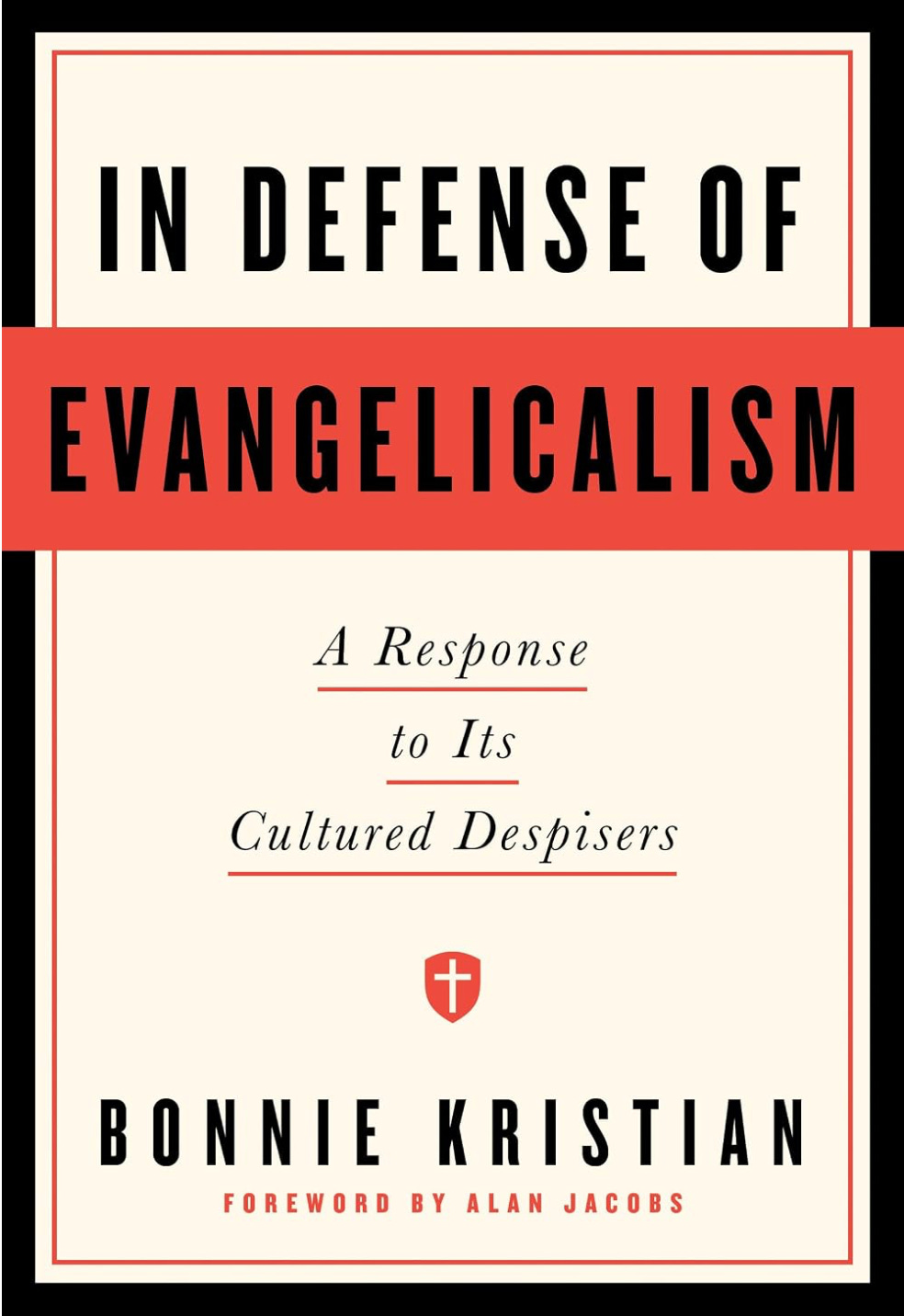
She’s an evangelical, and she’s not ashamed of it. She really believes that what evangelicals stand for is the power of God for salvation for all who believe. That is the ultimate defense in her new book (hitting the press today!), In Defense of Evangelicalism: A Response to Its Cultured Despisers.
For her, to be an Evangelical is to be resolutely committed to and (indeed) unashamed of the gospel of Jesus Christ—for it to infiltrate every nook and cranny of life, and for it to determine the meaning and purpose of literally everything. It’s in the name: the word Paul uses in Romans 1:16 is euangelion. Evangelicalism is just Gospelism.
In case you missed it, check out the Substack Live I did with Myles Werntz to talk with Bonnie Kristian about her book.
I remember making a similar claim to a new-found friend at Yale Divinity School in the fall of 2009. We were both attending new student orientation, and I self-described as an evangelical. (I was also a Pentecostal, but at that point I knew that my particular species of Pentecostalism fell under the genus of Evangelicalism.) My new friend was a liberal protestant, an Episcopalian, who was in favor of same-sex marriage and all the critiques of the Nicene tradition that were in vogue at the time (and in some circles still are). He asked me what I meant when I self-described as an “evangelical.” I sheepishly said, “well, I think the meaning is in the name—it’s a resolute commitment to the gospel of Jesus Christ and to evangelize (i.e. proselytize) accordingly.” By then I’d already had a lifetime of ecumenical experience to know that not all Christians were as interested in evangelizing as evangelicals were.
He laughed, mockingly, then condescendingly told me there was no way it was that simple. Looking back, I realize we were talking past each other. He was looking for a description of Evangelicalism, where I was offering a prescription for it. He was thinking of the movement’s legacy in the wake of the Bush administration. I was thinking about my missionary experience as a kid in West Africa where every evangelical missionary I met was there to evangelize. Liberal protestant and Catholic counterparts were there for relief work.
Kristian gets at the problem of the prescription-description divide in the conclusion of her book. She says that the “core claim of [Evangelicalism] is that ‘Christ Jesus came into the world to save sinners’” (quoting 1 Tim 1:15). She adds, “at our best, not caring what the world makes of us, this is how evangelicals live.” Note that she says this is evangelicals at their best. It’s a prescription, not a description.
Let me be clear: Kristian is not reductive. She has a most welcome and compelling negotiation of the term “evangelical,” drawing on its history, its sociology, Bebbington’s Quadrilateral, and the (astounding!) inconsistency of the identification in exit polls. Nor does she shy away from Evangelicalism’s descriptively bad behavior—she pulls no punches about the history of racism, sexism, financial and political corruption, and (even) cringiness.
But she’s equally unwilling to accept the caricature—favored by its despisers—that evangelicals are incognito power-grabbing hypocrites bent on creating a patriarchal dystopia. Engaging the confession and real, living evangelicals at the grassroots of America, Kristian makes a convincing case that there is no such sinister conspiracy.

More importantly, Kristian concludes that the solution to the very real problems of Evangelicalism in America is more Evangelicalism. More of the love of God made manifest in the love of neighbor, which is the hallmark of evangelical preaching and confession.
Each chapter of Kristian’s book is organized around a specific accusation against Evangelicalism whether in academia, politics, or punditry. The accusations are cumulative (which is why you must read it!), building on one another. So, for example, are evangelicals evil by nature (chapter 2)? No, but are they evil in practice (chapter 3)? Do evangelicals want to impose their beliefs on others? No, but do they still want to control the highest offices of the country (chapter 4)? Some do. Many don’t.
The deep irony is that in every critique Evangelicalism is the standard by which Evangelicalism is despised. Its critics are really just saying, “Evangelicalism isn’t measuring up to the love of God and neighbor that it claims.” As Kristian says, evangelicals are often quick to agree. They call it sin.
Evangelicalism is here to stay. And it won’t be through the power and influence of the Republican Party. It’ll be through mom groups at the local church, meatpacking immigrants in the rural Midwest, and the food pantries churches plant in urban food deserts. The American public needs to admit all of that, and treat the movement as a worthy neighbor to have. Because it is.
Perhaps the way forward is to recognize what Kristian and so many others she cites are doing. They’re turning outside critique into reform. Examples abound, including Kristin Du Mez’s own surprise at how well her Jesus and John Wayne: How White Evangelicals Corrupted a Faith and Fractured a Nation was received by evangelical leaders.
In Defense of Evangelicalism is going to make a splash in all the best ways. It’ll scandalize Evangelicalism’s most outspoken critics, it’ll edify the curious, and it’ll succor those who are (really) just trying to love Jesus and proclaim his euangelion. In my estimation, Kristian is just the conversation partner the American public needs to engage the emphatically American movement that Evangelicalism is.
Almost anyone can write a scathing analysis of any movement as big, broad, varied, and impactful as Evangelicalism. Sins are pervasive in any population, so all one needs to do is pick a topic and find some scandals.
I have been a Counselor and consultant who offers pro bono support for Ministers, Elders, and Missionaries for 25 years. I have seen my share of really bad people, but mostly men who were guided into ministry as young, talented men with a good speaking voice. Entry into the lofty realms of graduate school at age 25 and being sent out to preach at 30 means that a lot of men are in over their heads mentally, emotionally, and relationally, to say nothing of spiritually.
Leading a group of people who are older, wiser, and unwilling to change is an impossible task. My little church, as a child, averaged 50 to 75 in attendance, so we usually hosted young seminarians who came to practice on us. I asked my dad what we thought of one young guy, and he said, "We were here when he came, and we will be here when he goes." In other words, he will not have much impact on us.
I suggest that we withhold seminary enrollment from anyone who is under 40 and has children over 20. Timothy was in his mid 40s when Paul said, "Do not let anyone put you down for your youth.